The Investment Case
Why Timberland
Most asset classes offer one return driver. Timberland offers three — and all three compound simultaneously, independently of each other, over a 25-year horizon.
The Return Architecture
Three Layers. All Compounding.
Each layer operates on its own logic. Remove one and you still have two others working. Together they produce a return profile that no single-driver asset can replicate.
01
Biological Growth
The floor under everything else
A loblolly pine stand adds roughly 1 to 2 cords of merchantable wood per acre per year — every year — whether commodity prices move or not. The biological clock does not pause for recessions, rate cycles, or market dislocations. This is the return driver that has no market dependency. The trees grow. The volume accrues. The value builds quietly in the background while everything else fluctuates.
02
Timber Price Appreciation
Demand grows. Supply is fixed.
Southern yellow pine prices have tracked above inflation over long periods, driven by persistent demand from domestic construction, growing export markets across Asia, and emerging biomass and bioenergy applications. The supply side is structurally constrained — there is no mechanism to rapidly expand productive timberland. Well-managed pine ground in the Southeast is a finite, site-specific resource. Prices reflect that.
03
Land Appreciation
The asset beneath the asset
Productive timberland in the Southeast has appreciated quietly and consistently for decades — driven by conservation buyers, carbon land demand, development pressure around growing metro areas, and a simple reality: you cannot create more high-site-index pine ground. The land itself compounds independently of the timber growing on it. Remove the trees entirely and the underlying real estate still holds and appreciates. That land value is the permanent floor under the investment.
The Optionality Advantage
The Biological Put: You Can Always Not Harvest
Every other commodity position has a holding cost. Grain spoils. Oil storage costs money. Metals earn nothing. But standing timber does the opposite: when you defer a harvest, the trees keep growing, adding volume and shifting into higher-value product classes.
A stand of loblolly not harvested at age 20 does not sit idle — it converts pulpwood-class timber into chip-n-saw, and chip-n-saw into sawtimber. Each product class commands a meaningfully higher price per ton. The deferred harvest comes out of a more valuable stand than the one you chose not to cut.
This is what practitioners call the biological put: the option to wait is always available, and waiting is almost never a bad choice within the biological limits of the rotation. No other commodity works this way.
Geography Matters
Why Southeast Pine, Specifically
Not all timberland is equal. Site index, climate, mill infrastructure, and species mix determine whether a tract is a performing asset or a long-term holding problem.
Highest Site Index
The longleaf wiregrass flatwoods of North Florida and Southeast Georgia produce some of the highest loblolly and slash pine site indices in North America — meaning faster growth, shorter rotations, and more volume per acre than comparable investments in the Pacific Northwest or Upper South.
Year-Round Operations
No permafrost. No seasonal ground closures. Mild winters allow year-round logging, trucking, and site preparation — extending the productive window that northern timberland markets simply cannot match. More operating days means more flexibility in harvest timing.
Mill Infrastructure
Florida and Georgia together support one of the densest concentrations of softwood sawmills, pulp mills, and biomass facilities in the world. Mill competition — not mill dependence — is the operating reality for well-located timberland in this territory. Buyer competition drives price.
The Longleaf Premium
Longleaf pine stands in the wiregrass flatwoods carry economics that extend well beyond the standard 25-year rotation — plus carbon credit eligibility, biodiversity co-benefits, and premium hunting lease values. Most institutional portfolios do not hold longleaf at scale. It is a white-space advantage.
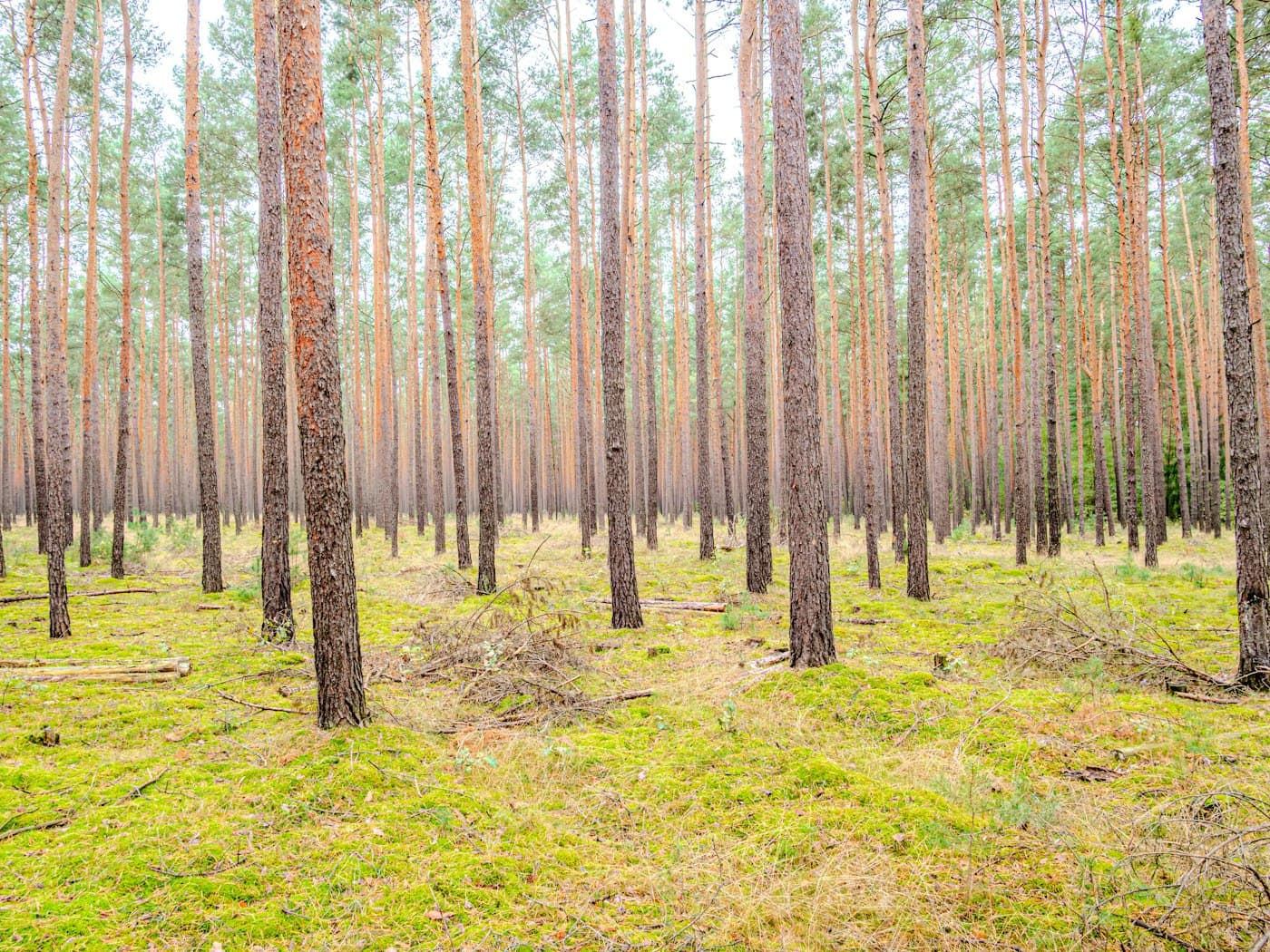
The trees grow whether markets cooperate or not. That is the foundation everything else is built on.
All Three Working Together
What 25 Years of Compounding Looks Like
The power of timberland is not any single return driver. It is all three operating simultaneously on the same acre of ground.
1
Years 1–7
Establishment
Site preparation, planting, and early herbicide release. Biological clock starts immediately. No merchantable timber yet — but the site index is compounding, the land is appreciating, and the stand is building the volume base that all future harvests come from. Pine straw harvest begins on eligible stands by Year 3.
2
Years 8–15
First Commercial Thinning
Midrotation thinning removes pulpwood-class material, improving crown ratios and accelerating growth on residual stems. First timber revenue event. The remaining stand shifts into higher product classes. Hunting and recreation leases are generating annual income. Carbon credit registration is evaluated on eligible stands.
3
Years 16–22
Second Thinning & Transition
Residual stand is producing chip-n-saw and sawtimber-class material. Second thinning captures additional revenue and sets final rotation density. Land value has appreciated independently of timber. Conservation easement eligibility is evaluated. The stand is approaching peak biological growth rate.
4
Years 23–25
Final Harvest
Full rotation sawtimber harvest through competitive bid process with multiple confirmed buyers. All three return drivers have compounded across the full rotation: biological volume, timber price appreciation, and land value. The tract is site-prepared and replanted — beginning the next rotation on a higher-value land basis.
The Ownership Advantage
Why Family Capital Gets More From Timberland
No Fund Term
Institutional TIMOs manage to a fund term — typically 10 to 15 years. When the term ends, the timber gets sold whether the market is favorable or not. A family with permanent capital harvests when the timber is ready, not when a redemption window opens.
No Forced Sales
Fund redemption cycles create forced sales at the worst possible times. A family holding timberland with no outside capital has no mechanism that forces a sale. The biological put remains fully available across the entire holding period.
No Mandate Conflicts
Institutional mandates create pressure to deploy capital even when land prices are high. A private family deploys when the basis is right, waits when it is not, and has no committee requiring them to put capital to work on a schedule.
Aligned Standards
When a family manages its own timberland, the standard applied to every harvest decision, every contractor relationship, and every market bid is the same one they'd apply to their own asset — because it is. That alignment is structurally impossible in a pooled vehicle.
See the Platform in Action
The investment case is built on three return drivers. The platform is built to capture all of them.